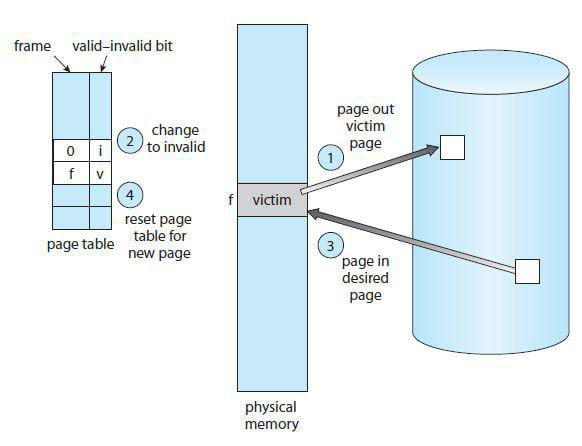
What is Page Replacement Algorithm?
- Global Page Replacement Algorithm:
- Local Page Replacement Algorithm:
Global page replacement algorithms work by selecting a page to replace from the entire set of pages in memory. This means that any page in memory can be replaced, regardless of which process it belongs to. Global page replacement algorithms are typically used in systems that have a relatively small number of processes running simultaneously.
local page replacement algorithms work by selecting a page to replace from only the pages belonging to a particular process. This means that each process has its own set of pages that can be replaced, and pages belonging to one process are not replaced if another process needs space. Local page replacement algorithms are typically used in systems that have a large number of processes running simultaneously.
Why do we need Page Replacement Algorithm?
Various Page Replacement Algorithms
First-In, First-Out (FIFO):
The FIFO algorithm works by replacing the oldest page in memory, regardless of how often it has been accessed. This algorithm is easy to implement, but it can lead to poor performance if the oldest pages are still being used frequently. This algorithm is useful in situations where the memory usage pattern is predictable and there are no time constraints.
Least Recently Used (LRU):
The LRU algorithm works by keeping track of the order in which pages are accessed. When a page needs to be replaced, the algorithm selects the page that has not been accessed for the longest time. This ensures that the pages that are most likely to be used again are kept in memory. This algorithm is useful in situations where the memory usage pattern is unpredictable, and frequently accessed pages need to be kept in memory.
Clock (or Second Chance):
The Clock algorithm maintains a circular list of pages, each of which has a reference bit that is set to 1 when the page is accessed. When a page needs to be replaced, the algorithm scans through the circular list until it finds a page with a reference bit of 0. If it finds a page with a reference bit of 1, it clears the reference bit and moves on to the next page in the list. This process continues until a page with a reference bit of 0 is found. This algorithm is useful in situations where the working set of a process is relatively small and the reference bit can be used to predict future page accesses.
Least-Frequently Used (LFU):
The LFU algorithm works by keeping track of the number of times each page is accessed. When a page needs to be replaced, the algorithm selects the page that has been accessed the fewest number of times. This algorithm is useful in situations where certain pages are accessed much more frequently than others.
Most-Frequently Used (MFU):
The MFU algorithm works by keeping track of the number of times each page is accessed. When a page needs to be replaced, the algorithm selects the page that has been accessed the most number of times. This algorithm is useful in situations where certain pages are accessed much less frequently than others.
Random:
The Random algorithm works by selecting a page to replace at random. While this algorithm is easy to implement, it can result in poor performance if frequently used pages are randomly selected for replacement.